
Robins: Spring Messengers of Joy
By Julie Thomas, PhD
Robins are a classic sign of spring, so why do we see robins in Lincoln during the winter? Although American Robins are classified as migratory birds, they are strategists when it comes to food availability. When Nebraska snow cover is high and food-foraging is limited, some flocks of robins migrate to southern areas where food is more available during winter months. Thus, the large influx of returning robins we experience in late February/early March is the perfectly timed return of thousands of migrants. Suddenly, our lawns are full of robins in search of worms!
Stand back, Punxsutawney Phil! Nobody signals spring with more confidence than the American Robin with their lawn-hopping dance and lyrical song: a musical whistle that sounds like “cheerily, cheer up, cheer up, cheerily, cheer up!” Perhaps this song has helped the American Robin come to symbolize renewal, hope, and new beginnings for many, as well as comfort and connection with the spiritual world for some.
Identifying Robins and Their Nests
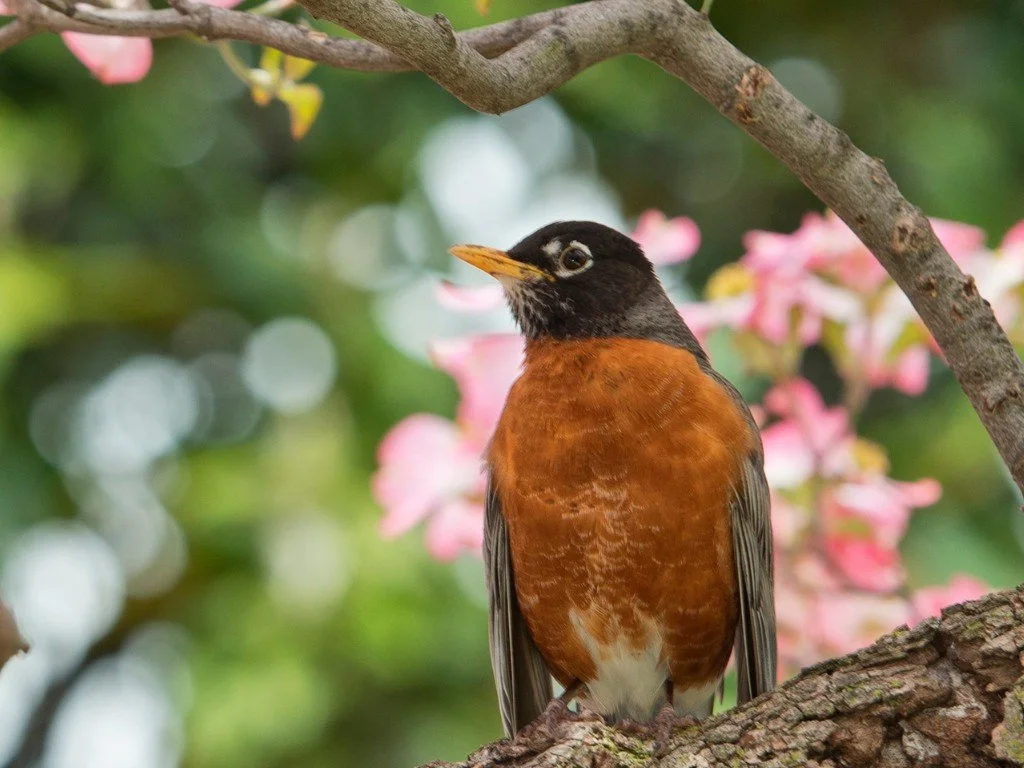
Robins pair-bond in early spring and begin building nests in mid-March. Males and females are similar in coloration: gray body, red breast, and a white eye ring, though males have a darker head and females are generally paler overall. Both parents defend the nest, but the females build the nest. Robin nests are quite distinct—woven materials glued together with mud—and usually found on branches in low shrubs or trees. Robins take advantage of any useful nest-building material, e.g., twigs, leaves, dry grass, feathers, plant fluff or down, moss, and pine needles.
Attracting Robins to Your Own Yard
Yes, you can help encourage robins to nest near you! My childhood memories include the presentation of bird-nesting materials as a spring ritual. My mom loved birds, and now I do, too. You can inspire the next generation of bird lovers (your kids, grandkids, and neighbors) by purposefully organizing building materials, i.e., small piles of leaves, twigs, and grass, and installing a mud puddle or ground-level bird bath just outside a viewing window.
Julie Thomas, PhD, is a retired Science Educator and a Research Professor Emerita from the University of Nebraska, and a contributing writer for 55+.