
Golden Summer Reads: Stories That Stay With You
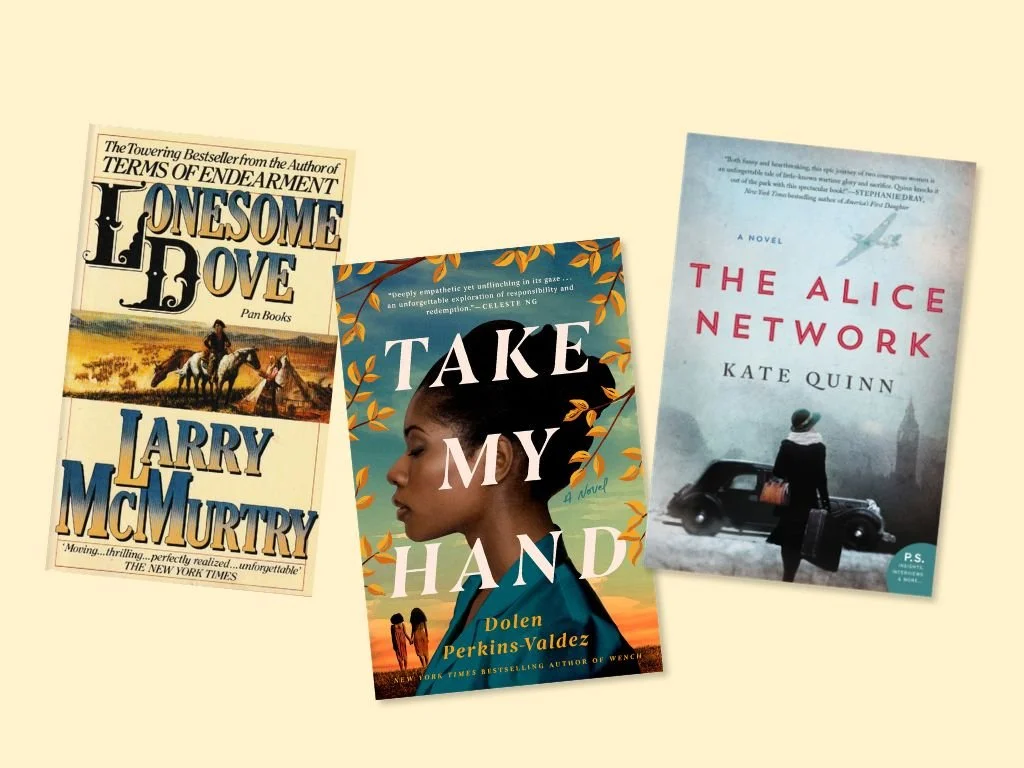
The Alice Network by Kate Quinn
"Steel blades such as you and I do not measure against the standards for ordinary women."
– Louise de Bettignies
A New York Times bestseller, The Alice Network is grounded in the little-known true story of a WWI spy ring operating in German-occupied France, led by the remarkable Louise de Bettignies—known as the "Queen of Spies." Quinn weaves two storylines across three decades: young Eve Gardiner, recruited in 1915 to infiltrate a restaurant frequented by German officers, and Charlotte “Charlie” St. Clair, a pregnant American college student in 1947 searching desperately for her cousin who vanished in Nazi-occupied France. These two women collide in London and embark together on a mission to uncover the truth, no matter the cost.
Quinn's dual timeline is one of the novel's greatest strengths—the WWI narrative crackles with espionage, danger, and moral complexity, while Charlie's 1947 journey brings urgency and a modern lens to the older story. Eve's wartime sacrifice and Charlie's determination are compelling, and together they illuminate themes of courage, betrayal, and the lasting damage that war inflicts on those who survive it. Some readers find Charlie's storyline less gripping than Eve's, and patience is warranted as the timelines converge—but the payoff is satisfying. The characters are flawed, memorable, and worth caring about.
Lincoln City Libraries has 11 copies of this book; available electronically
Take My Hand by Dolen Perkins-Valdez
"Our bodies belonged to us. Poor, disabled, it didn't matter. These were our bodies, and we had the right to decide what to do with them."
– Dolen Perkins-Valdez
This is not an easy book to read, but it is an important one. Set in Montgomery, Alabama in 1973, the story follows Civil Townsend, a young Black nurse working at a family planning clinic whose first patients are two sisters—India and Erica Williams—just eleven and thirteen years old, living in rural poverty. Civil's growing concerns turn to horror when the girls are forcibly sterilized without their knowledge or consent by the very medical professionals claiming to serve them.
The novel's title comes from Martin Luther King Jr.'s reported last words, and the weight of that connection is felt throughout. Perkins-Valdez masterfully brings Civil to life—her passion, her grief, her complicated reckoning with her own choices. The story unfolds across two timelines: the 1970s, in the shadow of Roe v. Wade and Watergate, and forty-plus years later, as an older Civil tries to reconcile both her successes and her failures.
Deeply empathetic yet unflinching, the novel explores responsibility and redemption, the dangers of good intentions, and the folly of believing that anyone can decide what is best for another person's life. Take My Hand won the 2023 NAACP Image Award for Literary Work-Fiction.
Lincoln City Libraries has 10 copies of this book; available electronically.
Lonesome Dove by Larry McMurtry
"It's not dying I'm talking about; it's living."
– Augustus McCrae
A Pulitzer Prize winner and widely regarded as the great American Western novel, Lonesome Dove is an epic set in the late 1870s during the final, fading days of the frontier. Two retired Texas Rangers, the taciturn Woodrow Call and the irrepressible Augustus "Gus" McCrae, co-own a modest cattle operation on the Texas-Mexico border. When word arrives that Montana is a cattleman's paradise, Call's restlessness sets the whole enterprise in motion—a dangerous cattle drive of nearly 3,000 miles through territory that is beautiful, brutal, and unforgiving. Along the way, McMurtry peppers the trail with an unforgettable cast: young Newt, hungry for the father who won't claim him; Jake Spoon, charming and fatally careless; and the resilient women—Clara and Lorena—who endure and outlast the men around them.
At its heart, this is a story about friendship, duty, unrequited love, and the passage of an era. McMurtry's language is simple yet profound, perfectly suited to cowboys and open plains, while his characters are richly human in their flaws and longings. The novel rewards patient readers willing to settle into its sprawling 900 pages; the slow accumulation of detail and relationship makes the losses, when they come, genuinely affecting. President Obama, in honoring McMurtry with the National Humanities Medal, observed that readers of Lonesome Dove "found out something essential about their own souls, even if they'd never been out West or been on a ranch." I felt the truth in that myself.
Lincoln City Libraries has 4 copies of this book; available electronically.
Tari Hendrickson is a member of two book clubs, one of which she founded over 20 years ago. She remembers the thrill when letters and words came together and made sense in first grade.